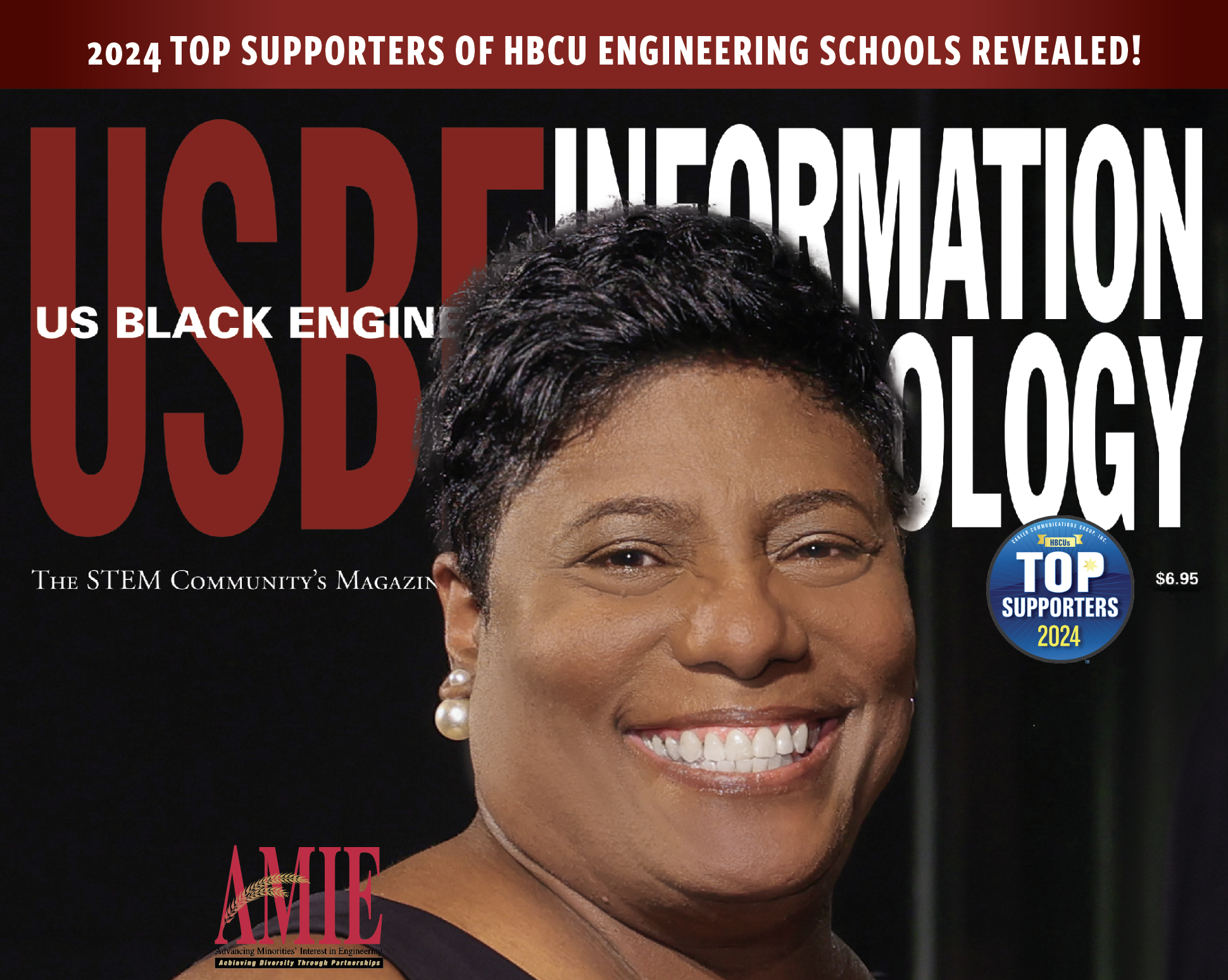
Mark Dean:
The Inventor at the Beginning -- Again
By Roger Witherspoon
In the beginning, Dr. Mark E. Dean didn’t know what he had done. That’s
a circumstance he won’t repeat.
"We didn’t have a clue," he said in an interview from IBM’s research
facilities in Austin, Tx. "The PC was just an interesting thing we did. If we
sold 200,000 PCs we thought we would do well, and pay off the investment, and
then we would go off and do something else. We just had hopes we would sell
enough to justify the project.
"We could not foresee where this was headed, that the PC would allow us
to be more productive. The PC allowed you to create and get information more
quickly than on paper. It had tremendous value, but we didn’t recognize
certain businesses that needed that capability."
He was part of a team at IBM research facilities in Boca Raton, Fla.
attempting to develop a more effective desktop computer, something which
became known as the IBM PC. Dr. Dean and a colleague, Dennis Moeller,
developed the interior architecture allowing desktop computers to share
information with printers and other devices. The result was the machine
which spearheaded the revolution to put computational power on the average
business and personal desktop.
Dr. Dean holds three of the original nine patents for the PC’s internal
architecture, the computer designated by Time Magazine as its Machine of the
Year. But at the time, Dr. Dean didn’t think it was a very big deal.
"We gave away the logics required to duplicate it," he said. "We did what
they used to do with old TV sets -- the logic was in the back so the repairman
could see it and repair it.. In this case, it allowed people to go off and
guild them themselves. That’s why the PC was so successful."
But Dr. Dean was quick to catch on as the PC led the modern technological
revolution in industry, education, and virtually every aspect of modern life.
He moved on to develop the PC AT -- for Advanced Technology -- which laid out
the industry standard architecture for personal computers. The new PC AT was
faster and could handle greater amounts of data than the standard PC.
He also is credited at IBM with spearheading the development of the
1-gigahertz processor chip at his Austin Research Lab. That product should
find its way into desktop applications in the next two to three years.
But Dr. Dean is now thinking past the PC. He readily acknowledges he did not
foresee the widespread implications of the desktop computer when he and his
colleagues developed it. Over the years he has participated in the
development of ever more powerful computers and networks. And he has watched
the disparity in computer availability grow between society’s haves and
have-nots, while the need for technological training and access have grown
exponentially.
And IBM has given him the opportunity to invent the future.
Dr. Dean has been promoted from Director of the IBM Research Lab in Austin to
Vice President of the newly formed IBM systems Division, operating out of its
headquarters in New York. "My new position is one of those dream jobs," he said. "There isn’t anything
we can’t do.
"There are about 300 people here. IBM wanted to put together everyone working
on systems -- operating systems and other software and hardware, the desk top
boxes, hand held devices -- everything. And we can build just about
anything we can imagine.
"I am pretty dangerous where I am right now. With the talent I have in this
group there is nothing that they can’t do. We will build some very
interesting things."
Dr. Dean has earned that position. In 1989, after receiving more than 20
patents for innovations in computing technology, he was named to the IBM
Academy of Technology. In his Texas research capacity he contributed to the
development of ever more powerful servers for office networks. In 1995 he
was named an IBM Fellow, a honor shared by 151 of the company’s top
researchers during its 88-year history. He was the first African American to
hold that post. He has since quickly climbed to the 10th, 11th, and 12th
level in the IBM Master Inventor Award Series -- and it takes three patents to
move up one level. In 1997 he was inducted into the National Inventor’s Hall
of Fame -- joining two other noted black members, George Washington Carver and
Dr. Percy Julian.
And what he wants to do in this new position, is develop the replacement for
the ubiquitous personal computer. In this case, what Dr. Dean envisions is
the ultimate communications device.
"The next step is the electronic tablet," he said, "and it is so much fun to
talk about."
Dr. Dean and his team are at work on a prototype of flat tablet "with all the
contrast and resolution paper has, and with enough resistance that you can
control your handwriting on it. That is difficult technology, but all the
other display technology we need we already have."
His tablet will hold everything. It will have a built in microphone and
digital camera, and wireless modem for Internet or telephone, fax, and cable
connections. It will be capable of displaying full motion picture video and
audio. This will make it the ultimate communications tool.
"Right now if you subscribe to a magazine, you get it in the mail, and it
contains print ads supporting it," Dr. Dean continued. "With this, you would
subscribe to the magazine, and then download. So now you have the ability to
generate revenue from the device -- something you can’t do now with the
computer.
"And it can display video and audio, so it won’t just compete for print ads.
Instead of selling just a page of ads, it will compete with Fox and NBC and
CBS to sell advertising time. You can transmit articles directly and show
the video ads as part of the magazine you download with each issue.
"This also works for reference books and catalogues. Each person in the home
could have one of these. You could buy them for about $100 and they would be
your information device -- your source for all sorts of information. They
would be capable of doing many more of the things we do today, and there is
money to be made from them."
The devices would have voice recognition capabilities, he said, and could be
used to open the garage or turn on the house lights. "There wouldn’t be
anything the device couldn’t do automatically.
"And it would have the ability to communicate back to you, if you wanted
that. Some people are afraid of talking to a device like that, but it has
the intelligence to think ahead of you. So if you are in the habit of
downloading US News and World Report and turning to certain pages to look at
stock quotes, it will recognize your reading pattern and go there for you.
"We can get very close to building that kind of device, and it will change
the way we deal with information. It actually starts to level the playing
field . Everybody should have one, and it would flatten the digital divide."
In the Dean scenario of tomorrow, every student would receive a tablet when
they entered school. "All of their homework, all reports, all of their books
would be on the device. Instead of lugging a lot of books, their texts would
all be right there and since information is dynamic, they can be updated as
required.
"Everything you do in school will come through that machine."
Much of the technology is already available, he said. "We already have a
microdrive that holds 350 Megabytes of storage on something the size of a
matchbook. In about three years, that will hold 10 gigabytes and be a little
bigger than a quarter. That will give you the power to do movies. It will
hold all the information you could create for an entire school year and
you’ve still got plenty of space. It has almost endless capacity, and we are
doubling storage capacity every year.
"As a learning device, kids respond if the content is more active. That’s why
Sesame Street was so successful. They were interested because they were
entertained, and an interactive device can do things for them. They could
also create their own content."
Presently, the most advanced classes -- usually in upper income areas --
are structured for distance learning, featuring desktop computers with
digital cameras and sound systems allowing students in one location to
participate in classes anywhere in the globe with an Internet connection. The
Dean wireless tablet would bring those capabilities to every classroom --
regardless of the lack of infrastructure in their physical school system.
It would also transform information handling and conferencing in the
workplace.
Dr. Dean ponders the future with a vision of what impact his team’s
inventions can have on the world.
"I hope that it won’t be too long before you can go to a museum to see a PC.
To live through the beginning of the PC era and the end is really special.
"But I think I will easily see us move that fast. There is an endless list of
opportunities."